
scale drawings worksheet 7th grade pdf
Scale drawings are essential tools in 7th grade geometry, bridging the gap between representation and reality, often found as printable PDF resources.
These worksheets focus on computing actual lengths and areas, alongside reproducing drawings at varied scales, enhancing problem-solving skills.
Mastering these concepts prepares students for real-world applications, utilizing number operations and proportional reasoning within geometric contexts.
What are Scale Drawings?
Scale drawings are precise, proportionally reduced or enlarged representations of real-world objects or spaces. They aren’t simply pictures; they maintain specific ratios, allowing us to determine actual dimensions. Often encountered as a 7th grade PDF worksheet, these drawings are fundamental in fields like architecture, engineering, and cartography.
These worksheets typically present geometric figures and require students to apply scale to calculate actual lengths and areas. The core concept revolves around understanding that every measurement on the drawing corresponds to a larger or smaller measurement in reality. A common task involves solving problems where students must use the given scale to find missing dimensions.
The printable nature of these resources allows for focused practice, reinforcing the relationship between the drawing and the object it represents. Successfully navigating these worksheets demonstrates a grasp of proportional reasoning and its practical applications, preparing students for more complex mathematical challenges.
Why Use Scale Drawings?
Scale drawings are invaluable because they allow us to represent large objects or spaces in a manageable format. Imagine trying to draw a city to its actual size – impractical! These drawings, often found as a 7th grade PDF worksheet, provide a solution by using a consistent scale to shrink or enlarge the representation.
Worksheets focusing on these drawings help students understand how to apply mathematical principles to real-world scenarios. They learn to solve problems involving distances, areas, and proportions, skills crucial in various professions. The ability to interpret and create scale drawings is essential for architects designing buildings, mapmakers creating geographical representations, and engineers planning infrastructure.
Furthermore, these printable resources offer a practical application of number operations and geometric concepts, solidifying understanding and fostering analytical thinking. Mastering this skill empowers students to visualize and analyze spatial relationships effectively.

Understanding Scale
Scale, often expressed as a ratio on 7th grade PDF worksheets, defines the relationship between drawing dimensions and actual sizes, aiding accurate representation.
Defining Scale as a Ratio
Scale in scale drawings is fundamentally expressed as a ratio, a direct comparison between a length on the drawing and the corresponding actual length it represents. Many 7th grade PDF worksheets emphasize this core concept, presenting scales like 1:10 or 1 inch = 5 feet.
This ratio isn’t merely a numerical value; it’s a statement of proportionality. For instance, a scale of 1:20 means that 1 unit on the drawing equates to 20 of the same units in reality. These worksheets often require students to interpret these ratios, understanding that if a line on the drawing measures 2 inches with a 1:20 scale, the actual length is 40 inches.
Understanding this ratio is crucial for accurately converting between drawing measurements and real-world dimensions, a skill heavily tested in scale drawing worksheets. Students learn to set up proportions based on this ratio to solve for unknown lengths, solidifying their grasp of proportional reasoning.
Reading and Interpreting Scale Ratios
Reading and interpreting scale ratios is a cornerstone skill reinforced by 7th grade PDF worksheets. These worksheets present scales in various formats – as fractions (e.g., 1:50), using the word “to” (e.g., 1 to 25), or with units (e.g., 1 inch = 10 feet).
Students must decipher what each part of the ratio represents. The first number always refers to the drawing’s measurement, while the second indicates the corresponding actual measurement. A worksheet might ask: “If a room measures 3 inches on a drawing with a scale of 1 inch = 8 feet, what is the actual room length?”
Successfully interpreting these ratios requires understanding unit consistency. Converting units (inches to feet, centimeters to meters) is often necessary before applying proportions. These PDF resources provide ample practice, building confidence in translating abstract ratios into concrete real-world dimensions.
Common Scale Examples (e.g., 1:10, 1 inch = 5 feet)
7th grade scale drawing worksheets frequently utilize common scale examples to build student proficiency. Ratios like 1:10 indicate the drawing is ten times smaller than the actual object; a 1cm line on the drawing represents 10cm in reality. Scales such as 1 inch = 5 feet are also prevalent, particularly in architectural or map-reading contexts.
PDF worksheets often present scenarios using these scales. For instance, a blueprint might employ 1 inch = 4 feet, requiring students to convert drawing measurements to actual building dimensions. Understanding these conventions is crucial for solving related problems.
Exposure to diverse examples – 1:20, 1:50, 1 inch = 10 miles – prepares students for varied applications. These worksheets emphasize recognizing the relationship between the drawing and the real-world object, solidifying their grasp of proportional reasoning.

Calculating Actual Lengths
Scale drawing worksheets for 7th grade PDFs emphasize using proportions to determine real-world dimensions from scaled representations, building crucial skills.
Students learn to solve for unknown sides, applying ratios effectively.
Using Proportions to Find Actual Lengths
Scale drawing worksheets, often available as 7th grade PDF downloads, heavily emphasize the application of proportions to unlock actual lengths from scaled diagrams. This is a cornerstone skill, requiring students to establish equivalent ratios between the drawing and the real-world object.
Typically, a worksheet will present a scale – for example, 1 inch = 5 feet – and a measurement on the drawing. Students then set up a proportion: (drawing length) / (actual length) = (scale denominator) / (scale numerator). Solving for the unknown ‘actual length’ involves cross-multiplication and division.
These PDF resources often include varied examples, progressing from simple one-step calculations to more complex scenarios involving multiple measurements. The goal is to build fluency in setting up and solving proportions, ensuring students can accurately translate scaled representations into real-world dimensions. Mastering this skill is vital for success with subsequent geometry concepts.
Solving for Unknown Sides in Scale Drawings
Scale drawings worksheet exercises, frequently found as 7th grade PDF downloads, often present geometric figures where some side lengths are known, and others are missing. Students must utilize the established scale and proportional reasoning to determine these unknown dimensions.
These worksheets build upon the foundation of setting up proportions, but introduce the added complexity of applying this knowledge to shapes. Students must identify corresponding sides on the drawing and the actual object, then construct a proportion to solve for the missing length.
Many PDF resources include diagrams of rectangles, triangles, and other polygons, challenging students to apply their skills in diverse contexts. Successfully solving for unknown sides demonstrates a comprehensive understanding of scale and its implications for geometric relationships, preparing them for more advanced spatial reasoning tasks.
Practice Problems: Finding Actual Dimensions
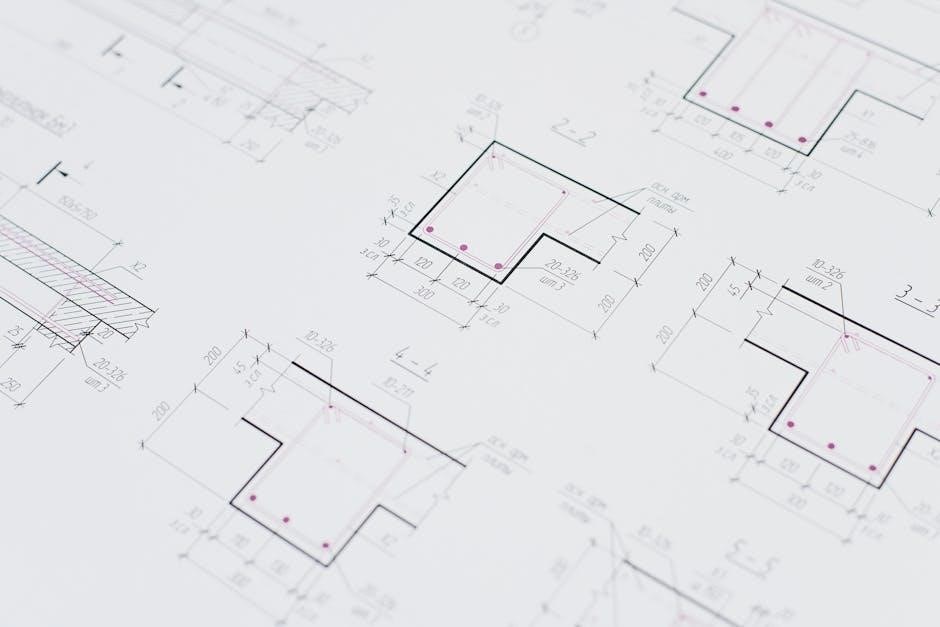
Scale drawings worksheet collections, readily available as 7th grade PDF downloads, heavily emphasize applying scale ratios to determine real-world, or actual, dimensions. These practice problems typically present a scale drawing alongside the scale itself, requiring students to calculate the corresponding actual lengths.
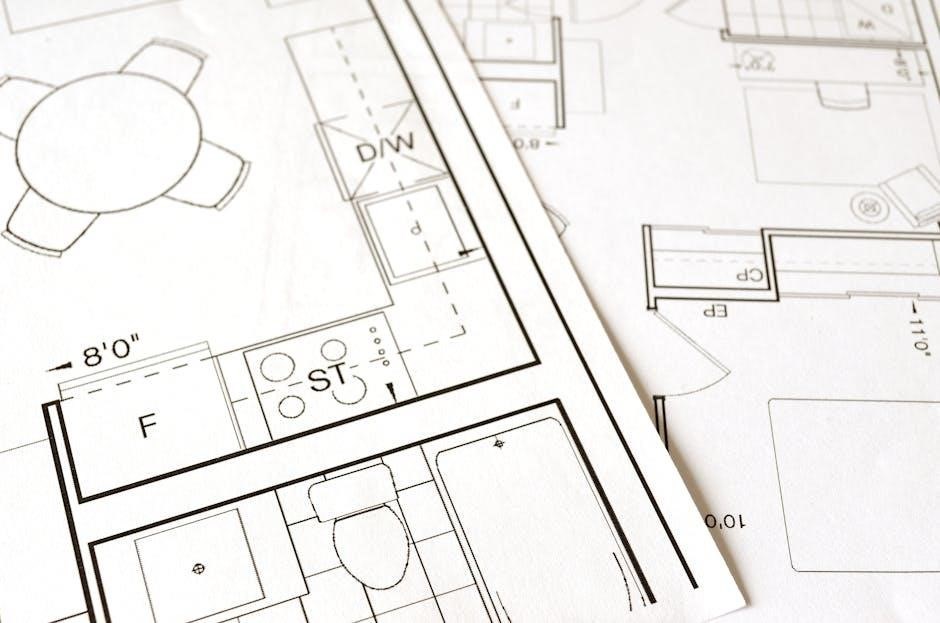
Common exercises involve finding the actual length of a room represented on a blueprint, or the real distance between two cities on a map. Students must correctly interpret the scale – for example, 1 inch = 5 feet – and set up a proportion to solve for the unknown actual measurement.
These PDF resources often include varied difficulty levels, starting with simpler problems and progressing to more complex scenarios. Mastering these problems solidifies understanding and builds confidence in applying scale concepts to practical situations.
Calculating Scale Drawing Lengths
Scale drawing worksheets, often in 7th grade PDF format, challenge students to convert actual measurements into their scaled representations using proportions.
This involves “working backwards” from known actual lengths to determine appropriate drawing dimensions.
Converting Actual Lengths to Scale Drawing Lengths
Scale drawing worksheets for 7th grade, frequently available as PDF downloads, heavily emphasize the practical skill of converting real-world, or actual, lengths into their corresponding representations on a scaled drawing.
This process fundamentally relies on understanding and applying the given scale ratio. Students learn to set up proportions where the actual length is related to the scale drawing length.
For example, if a scale is 1 inch = 5 feet, and the actual length of a wall is 20 feet, the student must solve the proportion 1/5 = x/20 to find x, which represents the length on the drawing (x = 4 inches).
These worksheets often present various scenarios, requiring students to consistently apply this proportional reasoning to different measurements and scales, solidifying their grasp of the concept.
Successfully mastering this skill is crucial for accurately creating scaled representations of objects and spaces.
Working Backwards with Proportions
Many 7th grade scale drawing worksheets, often found as PDF resources, challenge students to “work backwards” with proportions – a critical skill for problem-solving.
This involves being given the scale drawing length and needing to calculate the corresponding actual length. The core principle remains the same: utilizing the scale ratio to establish a proportion.
For instance, if a drawing shows a tree as 3 inches long, and the scale is 1 inch = 8 feet, students set up the proportion 1/8 = 3/x, solving for x to determine the tree’s actual height (x = 24 feet).
These worksheets frequently present scenarios where students must interpret scale drawings and deduce real-world dimensions, reinforcing their understanding of proportional relationships.
This “reverse” application solidifies comprehension and prepares students for more complex geometric challenges.
Practice Problems: Creating Scale Drawings
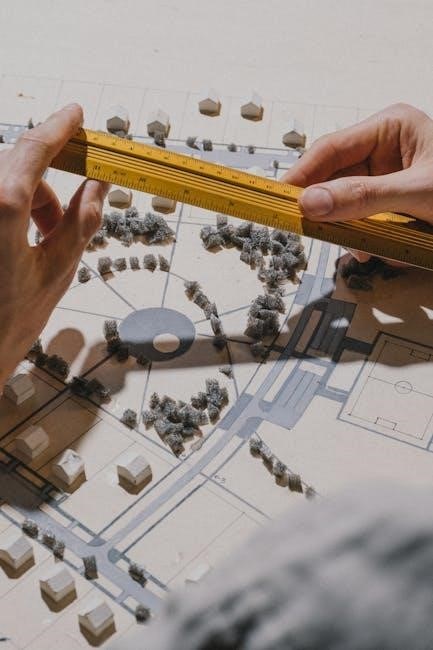
7th grade scale drawing worksheets, readily available as PDF downloads, often include exercises requiring students to create scale drawings, not just interpret them.
These problems typically provide actual dimensions and a specified scale (e.g., 1 cm = 2 meters). Students must then calculate the corresponding lengths on the scale drawing, demonstrating their proportional reasoning skills.
For example, if a room is 6 meters long and the scale is 1 cm = 2 meters, the drawing length would be 3 cm. Accuracy is key; students must carefully convert measurements and use rulers to construct precise drawings.
Worksheets may ask students to draw simple shapes, floor plans, or even more complex objects, reinforcing their understanding of scale and spatial relationships.
This active creation process solidifies their grasp of the concepts and builds confidence in applying them.
Area and Scale
Scale drawings worksheet 7th grade PDF resources explore how scale impacts area calculations, requiring students to determine actual or drawing areas using proportions.
Understanding this relationship is crucial for solving real-world problems involving scaled representations.
How Scale Affects Area
Scale drawings worksheet 7th grade PDF materials demonstrate a critical concept: area changes are not linear with scale. If a scale drawing reduces dimensions by a factor of 2 (a scale of 1:2, for example), the area doesn’t simply halve; it’s reduced by a factor of 2 squared, or 4.
This is because area is a two-dimensional measurement, relying on both length and width. Consequently, when both dimensions are scaled down, the area shrinks proportionally to the square of the scale factor. Worksheets often present scenarios where students calculate the area of a shape in a scale drawing and then determine the actual area, requiring them to square the scale factor.
Conversely, students might be given the actual area and asked to find the area in the scale drawing, necessitating the use of the inverse operation – taking the square root of the scale factor’s square. These exercises reinforce the understanding that area is intrinsically linked to the scale used in the drawing, and mastering this relationship is vital for accurate calculations.
Calculating Actual Area from a Scale Drawing
Scale drawings worksheet 7th grade PDF resources frequently task students with determining actual areas given a scaled representation. This process builds upon understanding how scale impacts area – it’s not a direct proportion, but a squared relationship.
Typically, students first calculate the area of the shape within the scale drawing using standard area formulas (length x width, or more complex formulas for other shapes). Then, they must square the scale factor to find the factor by which the drawing’s area differs from the actual area.
Finally, they multiply the scale drawing’s area by this squared scale factor to arrive at the actual area. For example, if a drawing has a scale of 1:5, the scale factor is 5, and its square is 25. The calculated area from the drawing must then be multiplied by 25 to find the real-world area. These worksheets emphasize precision and a firm grasp of squaring operations.
Calculating Scale Drawing Area from Actual Area
Scale drawings worksheet 7th grade PDF materials often present the reverse challenge: finding the area on a scale drawing when given the actual dimensions. This requires students to apply the inverse of the area scaling process.
First, determine the scale factor by comparing a length on the drawing to its corresponding actual length. Then, square this scale factor. This squared value represents the factor by which the actual area is larger than the drawing’s area.
To calculate the scale drawing’s area, divide the actual area by the squared scale factor. For instance, with a scale of 1 inch = 5 feet (or a scale factor of 1/5), squaring yields 1/25. The actual area must then be divided by 25 to obtain the area represented on the scale drawing. These exercises reinforce understanding of inverse operations and area relationships.
Worksheet Focus & PDF Resources
Scale drawings worksheet 7th grade PDF resources emphasize key skills like computing lengths, areas, and reproducing drawings at different scales effectively.
Online PDFs provide practice, reinforcing proportional reasoning and geometric concepts for 7th-grade students.
Key Skills Covered in 7th Grade Scale Drawing Worksheets

Scale drawing worksheets for 7th grade, often available as PDF downloads, heavily emphasize proportional reasoning as a core skill. Students learn to establish and interpret scale ratios, understanding the relationship between distances on a map or drawing and corresponding actual distances.
A significant focus lies on computing actual lengths and areas from scale drawings. Worksheets present scenarios requiring students to utilize proportions to solve for unknown dimensions, applying number operations accurately. Conversely, students practice converting actual measurements into their scaled representations.
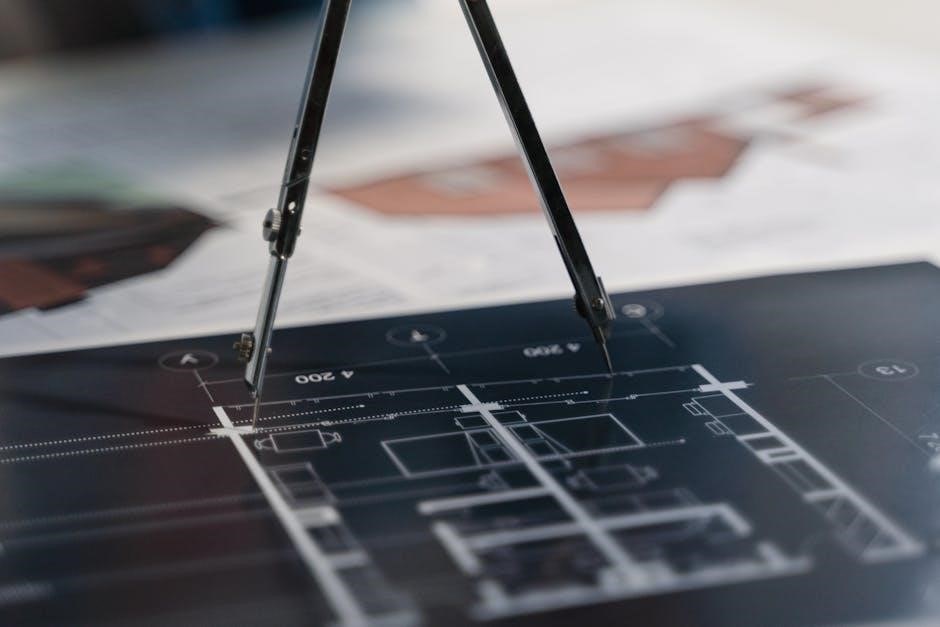
Furthermore, these resources build geometric understanding by requiring students to reproduce scale drawings at different scales, reinforcing their grasp of ratios and proportional relationships. They also develop skills in accurately measuring and constructing geometric figures based on provided scale information, preparing them for more advanced mathematical concepts.
Finding Reliable PDF Worksheets Online
Locating trustworthy scale drawings worksheet PDF resources requires careful navigation. Educational websites like K5 Learning, Math-Drills, and Khan Academy offer comprehensive collections aligned with 7th-grade standards. These platforms generally provide free, printable worksheets covering various skill levels.
Teachers Pay Teachers is another valuable source, featuring worksheets created by educators, often with detailed answer keys and differentiated options. When searching, utilize specific keywords like “7th grade scale drawing PDF” or “ratio and proportion worksheets” to refine results.
Always preview the worksheet before downloading to ensure it aligns with your curriculum and learning objectives. Prioritize sites with clear, accurate content and a professional presentation. Be cautious of websites with excessive advertisements or unclear sourcing of materials, ensuring the PDF is a reliable learning tool.
Tips for Completing Scale Drawing Worksheets
Successfully tackling scale drawings worksheet PDF exercises demands a systematic approach. Begin by carefully reading the scale ratio – understanding if 1 unit represents inches, feet, or another measurement is crucial. Always write down the scale ratio prominently before starting calculations.
When finding actual lengths, set up a proportion and solve for the unknown. Remember to maintain consistent units throughout the problem. For converting actual lengths to scale drawings, divide the actual measurement by the scale factor. Double-check your work, especially when dealing with area calculations, as errors can quickly compound.
Utilize a ruler and protractor for accurate measurements when creating drawings. Practice consistently with various PDF worksheets to build confidence and fluency in applying these concepts.